
The annual Lens on Africa Graduate Research Video Competition celebrates the hard work and achievements of UF graduate students conducting research on Africa or African-related themes. This year submissions were evaluated on three criteria: the clarity of the research objective and findings, the potential impact on the community and field of study, and the effectiveness of the visual presentation.
Winners received funds for research-related travel or conference participation, helping to further their academic and professional goals.
Check out their amazing videos below and get inspired!
2024 Winners
1st Place Winner of the Lens on Africa Graduate Research Video Competition

Kenneth Oduor
Department: Agronomy
Research Title: Sustainable management of the invasive cactus species (Opuntia stricta) in the rangelands of Laikipia, Kenya
Prize: $500 Travel Award
Video Overview:
Opuntia stricta, an invasive cactus in Kenya’s rangelands, reduces grazing land, affecting pastoral communities. Previous control efforts, like cochineal, failed, leading to a study exploring sustainable management. The research investigates using cactus biomass for biogas as cooking fuel and biodigester residues as biofertilizers. It also examines feeding male Galla goats with a cactus-based feed, replacing corn in their diet. We further evaluate the ecosystem services provided by the cactus within the rangeland with a focus on soil properties, including carbon sequestration. Finally, we explore its role in protecting plant diversity. The goal is to manage Opuntia stricta sustainably in Laikipia.
2nd Place Winner of the Lens on Africa Graduate Research Video Competition

Kaylin Kleckner
Department: Musicology and Ethnomusicology
Research Title: Genre formation as a social practice: A case study of Nnwonkoro
Prize: $150 Travel Award
Video Overview:
The western honey bee, Apis mellifera, is well-studied as managed livestock, but wild, unmanaged populations across Africa remain understudied. Kaylin Kleckner’s research focused on wild honey bee nesting ecology in the Eastern Cape, South Africa. Using beelining techniques, she located over 125 colonies, finding that colonies primarily nested in the ground inside old animal burrows. Her findings offer critical insights for land management, pollinator conservation, and the improvement of global beekeeping practices through the understanding of wild honey bees’ survival strategies.
3rd Place Winner of the Lens on Africa Graduate Research Video Competition

Naa Akle Okantey
Department: Entomology and Nematology
Research Title: Wild Honey Bees of South Africa
Prize: $250 Travel Award
Video Overview:
This video explores Nnwonkoro, a verbal art form performed by women in Akan communities and examines how this genre is constructed socially through a conscious sitting arrangement during performances. I analyze Nnwonkoro through the broader themes of gender and social power, considering how extramusical factors such as sitting arrangements help identify Nnwonkoro socially, as a women’s activity distinct from other genres like adowa, an Akan funeral musical culture. This video includes scenes of performances from the Kokofu Serwaa Nnwonkoro and Adowa Group, Sarfo Kantanta Adowa and Nnwonkoro Group, and the Legon Palmwine Band.
2025 Winners
1st Place Winner of the Lens on Africa Graduate Research Video Competition
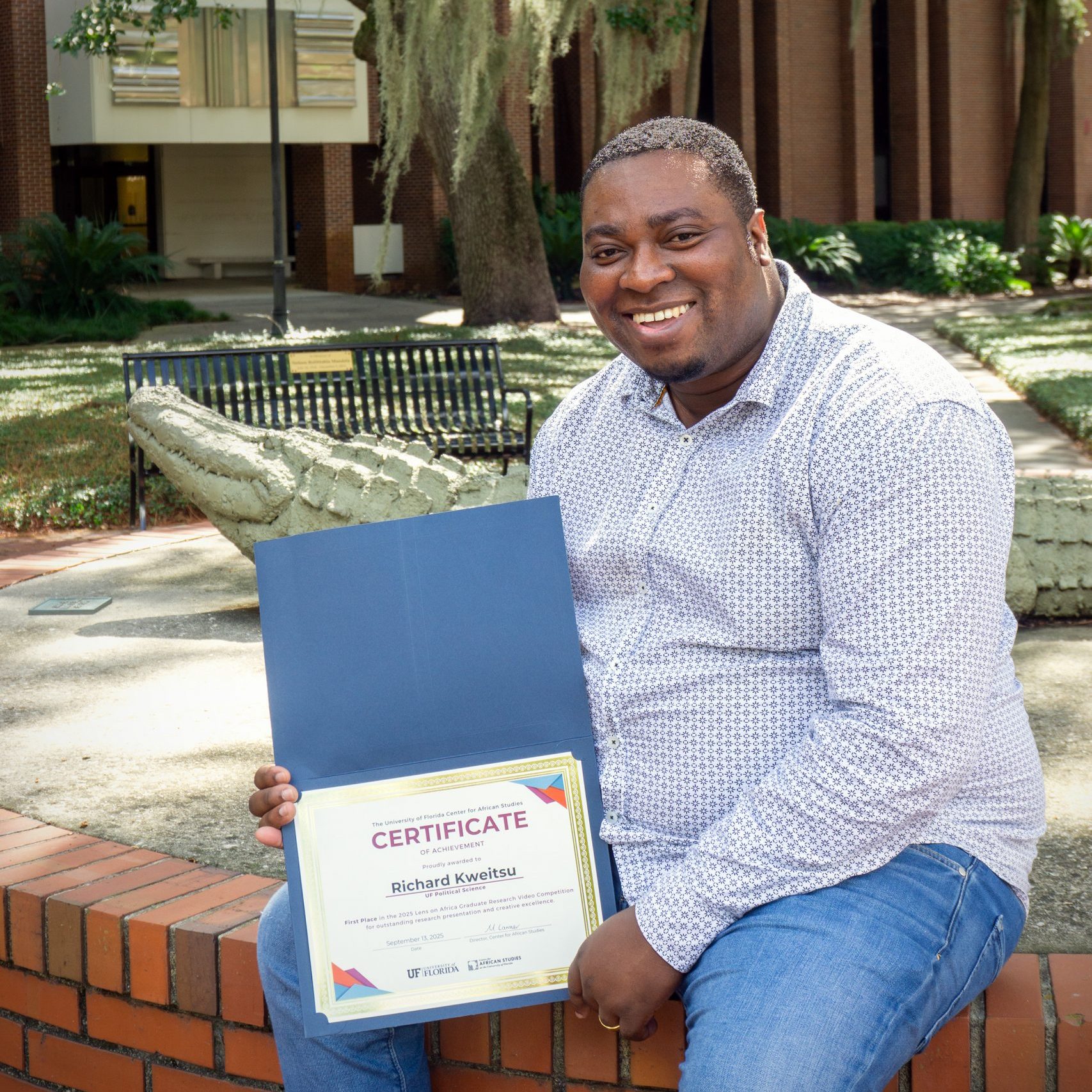
Richard Kweitsu
Department: Political Science
Research Title: From Ballots to Courtroom: The Impact of Post-Election Legal Disputes on Democratization in Africa
Prize: $500 Travel Award
Video Overview:
Richard Kweitsu explores how presidential election results are increasingly contested in African courts. This video explores how legal challenges are reshaping Africa’s democratic trajectory and follows his journey through Kenya, Malawi, and Ghana, where he investigates post-election legal disputes. Drawing from these experiences, he investigates two central questions: What motivates losing candidates to challenge elections? And what are the implications of these disputes for democracy? He presents a three-level framework—individual, party, and system—to explain the motivations behind election challenges, assessing both the potential benefits (such as reforms, reduced violence, and greater citizen engagement) and the risks (including judicial politicization, declining trust, and delegitimization).
2nd Place Winner of the Lens on Africa Graduate Research Video Competition

Audrey Smith
Department: Geography
Research Title: Language, Land, and Livelihoods: Fieldwork Across Tanzania’s Social and Ecological Landscapes
Prize: $250 Travel Award
Video Overview:
In August–September 2024, Audrey traveled across northern Tanzania for a unique blend of social and environmental fieldwork. She joined a Fulbright-Hays project developing a Swahili–English curriculum designed to help U.S. children learn about African culture, visiting schools and cultural heritage sites to ensure authentic representation. She also explored community-managed forests, learning from local stewards and collecting field data to monitor forest health over time using satellite imagery. In addition, Audrey met with Maasai community members to hear their stories of land loss to conservation, tourism, and large-scale land deals. Together, these experiences highlight the deep connections between people, places, and policy in understanding how land and livelihoods are changing.