The annual Lens on Africa Graduate Research Video Competition celebrates the hard work and achievements of UF graduate students conducting research on Africa or African-related themes. This year submissions were evaluated on three criteria: the clarity of the research objective and findings, the potential impact on the community and field of study, and the effectiveness of the visual presentation.
Winners received funds for research-related travel or conference participation, helping to further their academic and professional goals.
Check out their amazing videos below and get inspired!
1st Place Winner of the Lens on Africa Graduate Research Video Competition
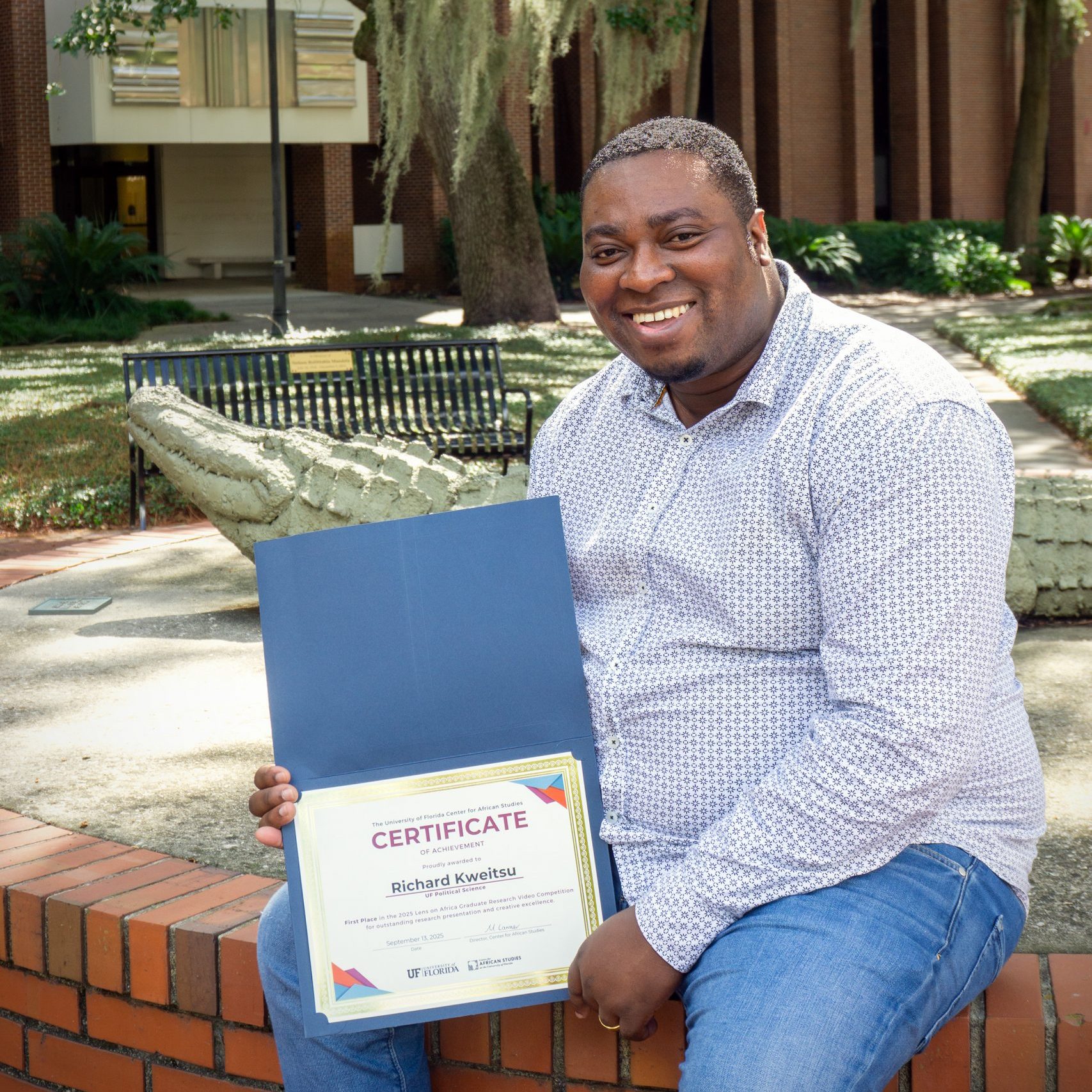
Richard Kweitsu
Department: Political Science
Research Title: From Ballots to Courtroom: The Impact of Post-Election Legal Disputes on Democratization in Africa
Prize: $500 Travel Award
Video Overview:
Richard Kweitsu explores how presidential election results are increasingly contested in African courts. This video explores how legal challenges are reshaping Africa’s democratic trajectory and follows his journey through Kenya, Malawi, and Ghana, where he investigates post-election legal disputes. Drawing from these experiences, he investigates two central questions: What motivates losing candidates to challenge elections? And what are the implications of these disputes for democracy? He presents a three-level framework—individual, party, and system—to explain the motivations behind election challenges, assessing both the potential benefits (such as reforms, reduced violence, and greater citizen engagement) and the risks (including judicial politicization, declining trust, and delegitimization).
2nd Place Winner of the Lens on Africa Graduate Research Video Competition

Audrey Smith
Department: Geography
Research Title: Language, Land, and Livelihoods: Fieldwork Across Tanzania’s Social and Ecological Landscapes
Prize: $250 Travel Award
Video Overview:
In August–September 2024, Audrey traveled across northern Tanzania for a unique blend of social and environmental fieldwork. She joined a Fulbright-Hays project developing a Swahili–English curriculum designed to help U.S. children learn about African culture, visiting schools and cultural heritage sites to ensure authentic representation. She also explored community-managed forests, learning from local stewards and collecting field data to monitor forest health over time using satellite imagery. In addition, Audrey met with Maasai community members to hear their stories of land loss to conservation, tourism, and large-scale land deals. Together, these experiences highlight the deep connections between people, places, and policy in understanding how land and livelihoods are changing.
**Prize money must be used for research-related travel in Africa or participation in an Africa-related conference presentation by June 15, 2025, at the latest.