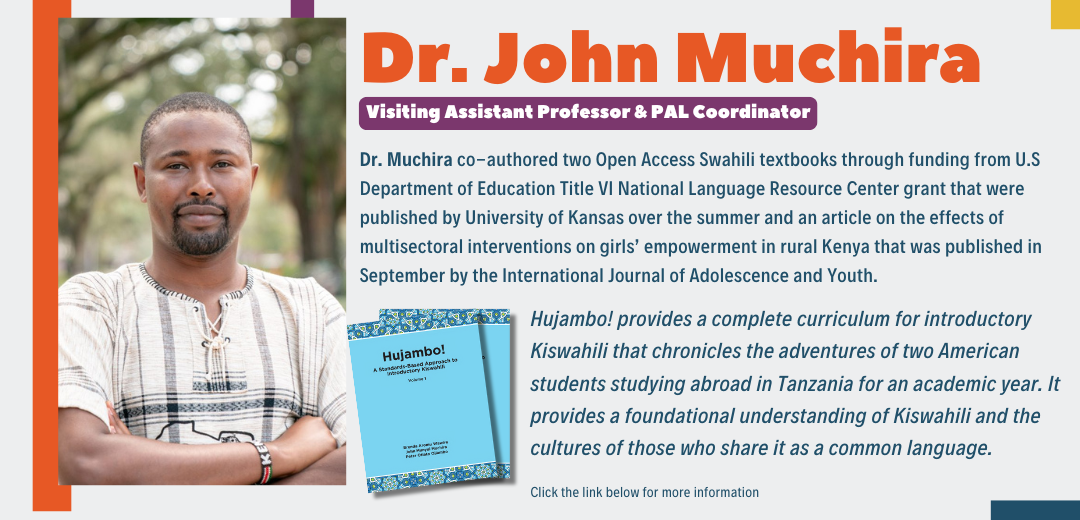
Dr. John Muchira, a Visiting Assistant Professor and Coordinator of African Languages at the Center for African Studies co-authored two Open Access Swahili textbooks through funding from U.S Department of Education Title VI National Language Resource Center grant that were published by University of Kansas over the summer and an article on the effects of multisectoral interventions on girls’ empowerment in rural Kenya that was published in September by the International Journal of Adolescence and Youth.
Two Open-Access Books on Standards-Based Approach have been recently published.
In collaboration with his former colleagues, particularly Dr. Brenda Wawire, a Research Faculty in the Learning Systems Institute at Florida State University, Dr. Peter Ojiambo, an Associate Professor in the Department of African and African American Studies at the University of Kansas, and Dr. Jonathan Perkins, the Director of the University of Kansas Open Language Resource Center, Dr. Muchira recently published two open Access textbooks, Hujambo! A Standards-Based Approach to Introductory Kiswahili, Volume 1 (June 2025) and Hujambo! Volume 2 (July 2025). The textbooks are part of an evidence-based, open-access curriculum that seeks to fill a gap in the literature on Open Educational Resources (OER) for teaching Less Commonly Taught Languages (LCTLs). In the Center for African Studies lecturer series, dubbed “Baraza,” on Friday, October 24th, 2025, Dr. Muchira will present the design and implementation of this theme-based foreign language curriculum. The textbooks offer a comprehensive curriculum for introductory Kiswahili, integrating 5Cs of the world-readiness standards, backward curriculum design, a task-based framework, and a storyline approach to chronicle the adventures of two American students studying abroad in Tanzania over the course of an academic year.
Each chapter of Hujambo is thoughtfully designed to integrate the 5Cs of the World-Readiness Standards for Learning Languages—Communication, Cultures, Connections, Comparisons, and Communities—providing a structured roadmap to language proficiency. The content draws from authentic materials and offers students numerous opportunities to engage in activities that target these core standards. This design approach provides insights into the students’ encounters with a new culture and how it (re)shapes their view of the larger world. The curriculum comprises seven thematic units across the textbooks’ Volumes 1 and 2. Each unit is centered around essential questions, with clear learning goals, and the learning activities reflect meaningful, real-life experiences that are cognitively engaging. Units begin with dialogues or monologues that model the language and target grammatical constructions, then move on to carefully scaffolded activities that encourage interaction and cultural exploration. Activities are designed using backward design and carefully integrate the 5Cs of the World-Readiness Standards to provide students with opportunities to engage in interpretive, interpersonal, and presentational communication, as well as to develop intercultural competence. The resource offers a model that can be adapted to design a curriculum for other LCTLs, especially African languages. More information on this lecture can be found here: https://calendar.ufl.edu/clas_africanstudies/event/49380-open-educational-resources-in-african-languages.
Swahili Language and Culture in the Digital Era: Dr. Muchira is currently teaching Beginning Swahili 1: SWA 1130, both in-person and asynchronously. In collaboration with Dr. Rose Lugano, a Master Instructional Professor of Swahili Language and Culture, and a team from the UFIT Center for Instructional Technology and Training, Dr. Muchira has developed online materials for this course, and for the first time, UF Swahili is offered 100% online. Dr. Muchira will also teach Beginning Swahili 2: SWA 1131, in Spring 2026, also 100% online. Dr. Muchira previously taught Intermediate Swahili and has taught the Advanced level at other institutions. Swahili or Kiswahili is one of the most widely spoken and studied indigenous African languages, with about 200 million speakers. It is a working language of the African Union, the official language of the East African Community, a national language in Kenya, Tanzania, and the Democratic Republic of Congo, and is spoken in over 14 countries. Kiswahili historically developed as a trading language mainly through contact among Bantu-speaking communities, Arabs, Persians, and Indians.
Program in African Languages Coordination: In addition to teaching Swahili courses Dr. Muchira also works closely with other Faculty at the Center for African Studies and the Department of Languages, Literatures and Cultures to strengthen and promote various key languages spoken across sub-Saharan African including Akan/Twi (Ghana – West Africa), Wolof (Senegal and the Gambia – West Africa), Yoruba (Nigeria and Benin – West Africa and the Diaspora), and Zulu (South Africa). He is keen to support the development of online resources in line with the UF-CLAS-Shared Language Program and the PAL strategy to grow African languages beyond UF. This initiative allows students enrolled in the State University System of Florida (SUSF or SUS) and the Florida College System (FCS) to study an African language by paying their home institution’s fees if their current institution does not offer that language.
Interdisciplinary Research: Dr. Muchira is a multidisciplinary researcher with training and research expertise in African studies, curriculum design, education policy, language pedagogy, entrepreneurship education and training, multicultural and international education, and youth development. He has served as an educator, researcher, and policy developer and has published peer-reviewed journal articles, project reports, working papers, policy briefs, and blogs as a lead author or collaborator. Dr. Muchira’s scientific research has been published in the Journal of Education and Learning, Information and Learning Sciences, Higher Education Studies, Frontiers in Education, Africa Journal of Management, Journal of Vocational Education & Training, Journal of Adult and Continuing Education, Journal of National Council of Less Commonly Taught Languages, and IDS Bulletin, among other peer-reviewed journals. He recently published an open-access article titled “Effects of multisectoral interventions on girls’ empowerment: results from the adolescent girls Initiative randomized trial in Wajir County, Kenya” in the International Journal of Adolescence and Youth. This article is helpful for scholars and practitioners interested in understanding interventions that can empower adolescent girls in marginalized settings, where barriers and challenges limit their agency and overall participation in society. In this study Dr. John Muchira and his former colleagues at the African Population and Health Research Center utilized data from Population Council on Adolescent Girls Initiative Kenya (AGIK), a cluster randomized trial designed to test whether different combinations of multisectoral interventions involving violence prevention, education, health, and wealth creation on adolescent girls’ empowerment, targeted to young adolescent girls (11–14 years), can improve their well-being. The study focuses on Wajir County in Kenya – a region categorized as Arid and Semi-Arid Lands (ASAL), and characterized by pastoralism as the major economic activity, low population density, low wealth index, limited infrastructure development, limited access to social amenities such as education and health facility, high number of out-of-school children (OOSC), strong social and cultural norms and practices, and minimal women agency, freedom and autonomy due to cultural values and beliefs closely associated with Islamic religion.
Project management and call for collaborators: John has experience managing projects, designing and piloting tools, leading stakeholder inception workshops, and facilitating seminars to validate and disseminate findings. He has lead and contributed to scientific report such as the Learning assessment during the COVID-19 pandemic in Africa and Financing Education in Africa during COVID-19 Pandemic, working papers for instance on the Effects of COVID-19 Pandemic on Low-Cost Private School Markets in Nairobi, and government reports for instance the Report of the Presidential Working Party on Education Reform: Transforming Education, Training and Research for Sustainable Development in Kenya, and several policy briefs. Dr. Muchira welcomes opportunities to engage with scholars and students in developing and executing projects under the NAFSI working group. He brings extensive experience as an educator, research scientist, program leader, and policy development specialist having contributed to a wide range of initiatives supported by prominent institutions such as the African Development Bank (AfDB), the Association for the Development of Education in Africa (ADEA), the British Council, the Center for Global Development, Education Development Trust, the Gates Foundation, the Foreign, Commonwealth & Development Office (FCDO), the International Development Research Centre (IDRC), the Swedish Association of Sexuality Education (RFSU), the United Nations Children’s Fund (UNICEF), and the World Bank.
Current Initiatives and Opportunities for Partnership:
Dr. Muchira recently established the National African Skills Initiative (NAFSI), a platform whose name, in Swahili and Arabic, means ‘self,’ ‘soul,’ or ‘personal,’ and whose mission is to promote Africa’s identity through language and culture and unlock the full capacity of African talent and Africanists’ aspirations. In the spirit of collective growth, NAFSI invites scholars, practitioners, institutions, and students to partner in advancing its mission through a three-pronged strategy inspired by the stability and balance of the traditional African three-legged stool:
- Cultural and Linguistic Empowerment – Co-develop and promote African language and culture programs for both heritage and non-heritage learners to acquire foundational linguistic skills and build cultural proficiency.
- Skills for Economic Participation – Join efforts to identify critical skills required for Africa’s evolving economies, and collaborate in designing study abroad initiatives, experiential learning opportunities, and demand-driven professional development programs that enhance livelihoods.
- Strategic Partnerships for Sustainable Development – Partner with private, public, and non-governmental institutions to build competencies across diverse economic sectors, ensuring communities across Africa can achieve their full potential, secure equitable and sustainable livelihoods, enjoy fulfilled, meaningful, healthy, productive lives, and access lifelong learning opportunities.
NAFSI is open to partnerships that share a commitment to African-centered innovation, linguistic and culturally diverse knowledge systems, demand-driven capacity building, and transformative impact.
Dr. Muchira is also actively seeking collaborators for innovative projects at the intersection of Artificial Intelligence and African languages, aiming to shape Africa’s digital future and rapid technological transformations with emerging technologies grounded in the continent’s rich multilingual and multicultural ecosystems.